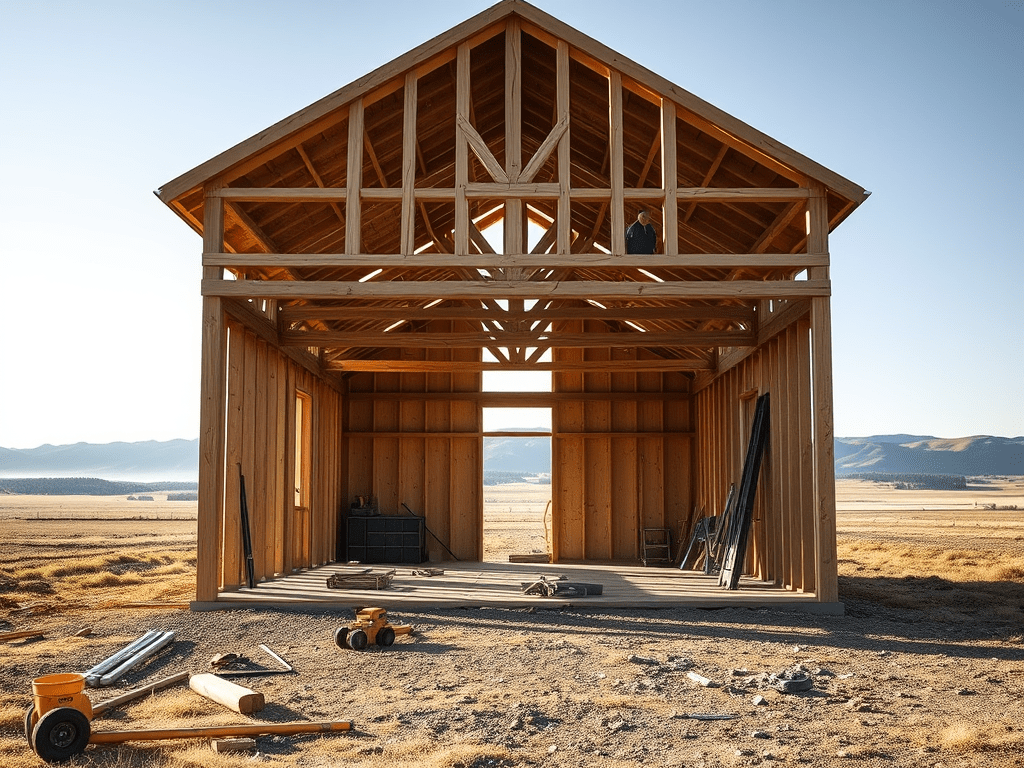
Cora was recruited to help her father and brother on the construction crew. I present to you her fresh perspective on the building of a pole-barn.
Five-thirty A.M., the alarm blares, jolting Cora out of dreamland. She groans and reaches over to shut off the obnoxious beeping. Her arm thumps around the night stand, knocking over everything on it but the beeping persists. Then Cora remembers that her Evening Self had put the alarm clock on the other side of the room so Morning Cora would actually have to get up. She rages at herself as she stumbles across the room.
Some mornings she will stay upright, shower and prepare for the day. Other mornings she simply falls back into bed to be awakened by Arnold twenty minutes later, thus shortening her preparations to five minutes. Fortunately, she looks like a troll either way.
The party heads upstairs where Mom has prepared blackened charcoal disguised as toast. Cora tries not to watch Arnold slather his toast with a half- cup of butter – she already has trouble eating charcoal without the addition of this nauseating scene.
Once Arnold and Cora get into the freezing truck, Cora falls asleep to the sound of Arnold rubbing his hands together and saying, “Oh, Custer, I don’t want to go!” After hearing this thirty mornings in a row Cora asked him what this meant. That day she fell asleep to a tale of Custer’s soldiers complaining on the way to the infamous “Custer’s Last Stand.”
The first day at a job site is always the worst. Much of it is spent being used as a pack mule. All work likely qualifies as slave labor. Eighty pound bags of concrete mix has to be put by every hole while Arnold scurries about cleaning out holes. Eventually the posts are placed in the holes and Cora stands by, shovel in hand, waiting with a heavy heart for the words, “Cover ‘er up!” Loosely translated, this phrase means the shoveler is expected to become a mad blur and have the entire pile of rocky soil back into the hole in twenty seconds. Or that’s the impression the shoveler is given. Dad and Arnold chat lightly, interrupted only by the shoveler’s wracking wheezes.
They rarely acknowledge the Unfortunate Shovel Wielder, and only then to make degrading jokes or to grin and say, “Hey, we’re almost half done!”
Between post-holes Cora leans on her shovel – an easy thing when one’s weak, quivering body crash-lands on top of it. She lies there, gasping, until from the next hole she hears, “Cover ‘er up!”
Framing the building is much easier. All Cora has to do is carry every piece of lumber to the right place, haul out the air compressor, fetch the guys’ favorite hoses and nailers, supply them with nails, water, conversation, pencils, and be there to hand up the lumber with a serene smile on her face.
She enjoys the process of setting trusses. Dad drives the skid steer, Arnold runs the sidewall, and Cora guides the truss from the ground.
After one unfortunate incident involving uneven ground, a flapping truss, and a crooked post, she was ordered to never, under any circumstances, release the tail of truss. Later, the angry, spitting beast and the skid steer dragged her across one gooseneck trailer and several bunks of lumber. “Why in the Harry didn’t you let go of the truss?!” were the words of apology.
When given the choice between handing up metal from the ground or helping to pull it up from the roof, Cora always chooses exhausting ground work over light and terrifying roof work. When she isn’t given a choice, she braves the rooftop but spends her time reflecting on the beautiful seventeen years she’s been given.
One fine day Cora and her Dad were putting metal on an eighteen-foot building. She held one end of the sheet of metal and Dad grasped the other as he propelled them across the roof at astonishing speeds.
“This could not get worse.” simultaneously with the thought, her foot slipped. She shoved her heart back down her throat and kept pace with Dad.
Her foot slipped again. After a few harrowing minutes of this (all spent in fervent prayer), she told Dad, “These shoes are terrible! It feels like I’m going to fall.”
He looked down at her feet. They were on the way back across the roof so both were empty handed. “Lemme see.” He took a few steps closer and— WHAP!— kicked her foot. Before she regained the power of speech— WHAP!—he kicked the other foot. “You’re fine,” he gently comforted, then marched away.
Screwing off the sidewalls is peaceful. Occasionally Cora hears angry shouts when one of the guys cuts a piece of metal too short. MQS always sent an extra piece of metal in case these mistakes happen, so you would think the anger should only last as long as it takes them to replace it. You would be wrong. Apparently, the proper etiquette in this situation is to stamp angrily about and hurl hurtful words for the remainder of the day.
Of course, most of what Cora does is pick up trash. Endless amounts. Whenever Dad opens his truck door Cora knows there will always be a pile of empty powdered doughnut bags to pick up.
She occasionally cleans out the trailer but this angers the men each time because the tools are on the shelf instead of in piles on the floor where they belong.
The experience taught Cora lots of things: a screwdriver and a drill are not one and the same.
Men work harder than you realize.
People are very resilient (this was also illustrated in stories of the Holocaust, so I don’t pretend to be the first to find this truth).
And ultimately, men morph into cavemen on the job-site.

 The Write Perspective
Leave a reply to Winston Sommers Cancel reply